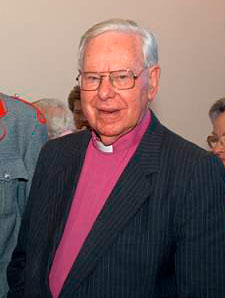
vale Marcus Loane
Filed under vale
Jesus’ healing in Luke
“The general question which arises from the whole account of his healing ministry is, of course, ‘Does he do the same today?’
My own view (and it is no more than that, on a matter where there are such divergent views) is this. Luke presents throughout this whole section a Jesus who utters words of power, and in these particular instances a Jesus who is the Healer of men’s ills. And Jesus is the same today: ‘Thy touch still has ancient power; No word from Thee can fruitless fall.’ But his methods are his own, and not the over-simplified ones his patients would sometimes prescribe for him.
I would therefore make a broad distinction between two methods of healing: not the obvious distinction between the miraculous and the medical, but one which lies deeper than that. Where his object is to be known as the Healer, he works immediately; such cures are, as it were, for the shop-window – the kind of success story which establishes the reputation of a great surgeon or physician. I see no reason why in some circumstances today Jesus may not choose to work in this way and for this purpose. But where he is already known, he may well say to his trusting patient:’I could of course give you immediate relief; but I would rather take the opportunity to do something more far-reaching, which will be to your greater benefit in the long run. You will find it more protracted and perhaps more painful, and you may not understand what I am doing, because I may be treating disorders of which you are yourself unaware.’
He will then set to work to deal with the needs of the whole person, rather than with the obvious needs only. He may aim at a calming of spirit, or a strengthening or courage, or a clarifying of vision, as more important objectives than what we would call healing. Indeed the latter may not be experienced at all in this life, but only at the final ‘saving and raising’ of the sick, when their mortal nature puts on immortality.
For I think it is no accident that each of these two words in James 5 has a double meaning, making them equally applicable to this life and the next: sozoI, to heal, or to save; egeiro, to raise from sickness, or to raise from death. The ‘prayer of faith’ cannot fail to bring about this result, one way or the other. But the faith in which such prayer is prayed must be, not faith that Jesus will heal in some particular way (ie. The way we should advise him to do it!), but faith in Jesus the Healer, who will choose his own timing and method. Then even today his word of power in this respect will amaze onlookers (4:36) and bring other to seek him (4:40).”
Michael Wilcock, The Message of Luke (Leicester: IVP,1978),67-8.
Filed under Uncategorized
next bookclub book
You may be:
· A new Christian, struggling to change former habits
· An older Christian who has plateaued – you grew quickly when you first believed but now your Christian life is much of a muchness
· A Christian who’s fallen into sin in a big way, wondering how you’ll ever get back on track
This book is about hope in Jesus, hope for forgiveness, hope for true and lasting change. God promises liberating grace and transforming power to his people.
Retail price: $15.00. Special Digging Deeper Bookclub price: $12.00. 200 pages, with discussion guides. Available from this Sunday at the College of Ministry table at St Paul’s, and from John Hooton and Glenhaven.
Filed under bookclub
no perfect people allowed
Vale Ken McKay
[from readbetterpreachbetter.com – Ken was a member of our 10am congregation. A lovely, humble Christian man, who served the church with his gifts and gave the glory to God. A delight to have known.]
Kenneth L. McKay was the grandfather of Greek verbal aspect. First writing on the subject in 1965, he published numerous articles over the following thirty years, and was the author of A New Syntax of the Verb in New Testament Greek: An Aspectual Approach. Without a doubt, his was the major influence behind the ‘new aspect era’, launched by the works of Stanley Porter and Buist Fanning in 1989/90.
Ken died yesterday morning in Sydney of a sudden heart attack.
Ken was a lovely Christian man, who for 26 years lectured in classics at the ANU in Canberra, and was for many years the area chairman of AFES in that region. He leaves behind his wife Margaret, seven adult children, and a tribe of grandchildren.
His contribution to the study of New Testament Greek will, in time, be seen as one of the most important of the twentieth century. He will be greatly missed.
Filed under vale
coming together
the meaning of life is not ’42’
Keller on the 2 ways sin plays out
Sex loses lustre in the art of selling
SEX doesn’t sell, Nokia tunes make people feel physically sick and Apple is a mini-religion.
So says global marketing guru Martin Lindstrom, who has used the latest medical technology to scan people’s brains and gauge their reaction to advertisements, jingles and product smells.
“What we learned was amazing. The most important senses when building brands were the sense of sound followed by smell then followed by sight. It’s ironic that 83 per cent of all brand communication only appeals to the sense of sight,” said Mr Lindstrom, the author of the best-selling book Buyology — Truth and Lies About Why We Buy.
“We learned that the Nokia tune turns people off. It is so disliked in our brains that we almost feel physically sick when hearing it. The reason for this is that it reminds people about work, missed deadlines and their boss calling them.”
Read the rest of the article from the Australian here.
Filed under advertising, culture, sex