

Then the LORD said to Moses, “Stretch out your hand toward the sky so that darkness will spread over Egypt—darkness that can be felt.”
Exodus 10:21
I wonder what that sort of darkness felt like?
Filed under exodus
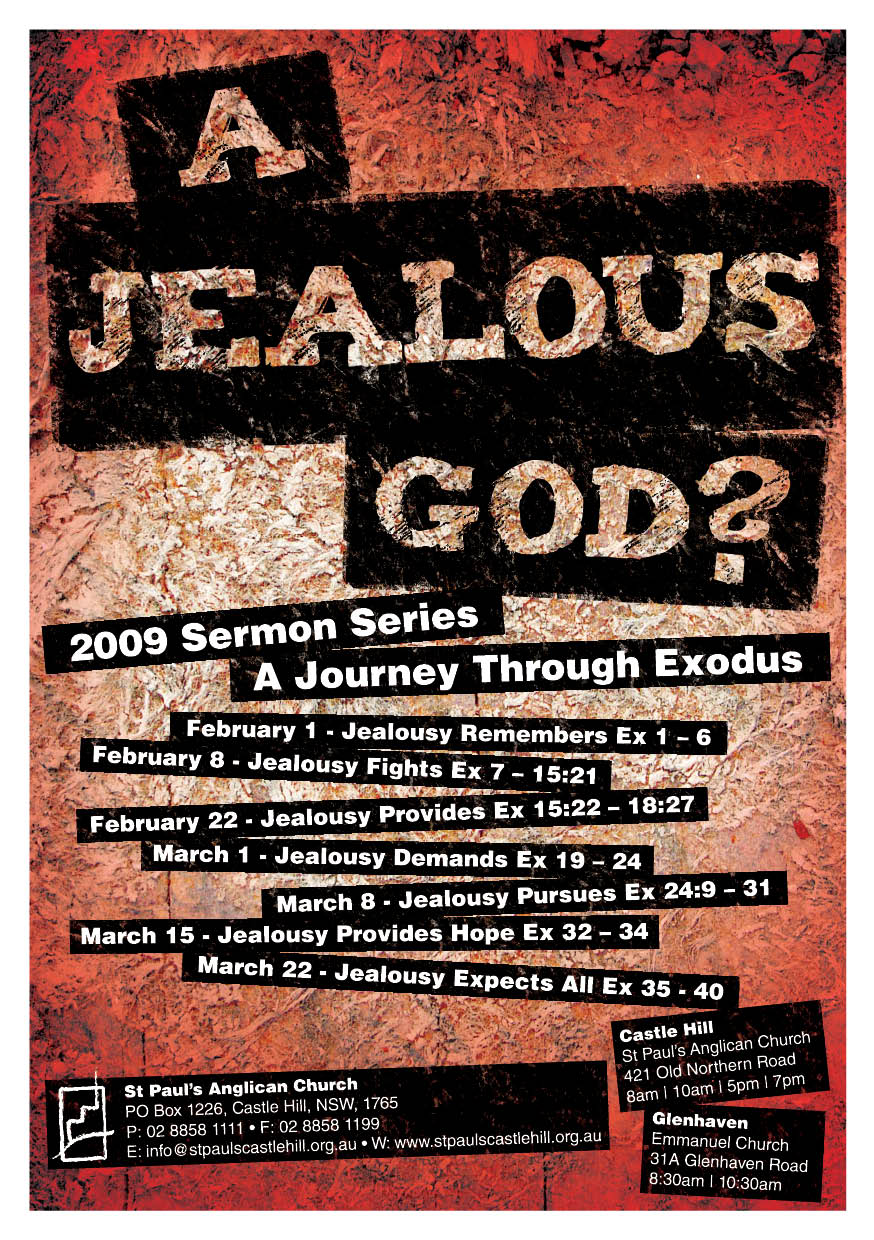
I’m under the pump to have our church’s Exodus bible studies ready for the Exodus breakfast this Saturday, but I noticed this and wanted to share.
I was looking at the promise that God makes after giving the law at Sinai:
‘Then have them make a sanctuary for me, and I will dwell among them. Make this tabernacle and all its furnishings exactly like the pattern I will show you.‘ Ex 25:8-9
I was thinking about how that promise is true for those living on this side of the cross, who don’t move around the desert setting up big tents anymore. I remembered John 1:14:
‘The Word became flesh and made his dwelling (lit: ‘tabernacled’) among us.‘
But it was when my mind went to Matthew’s gospel that I noticed something really cool (which I have probably been taught somewhere or other but forgotten): ‘God With Us’ is the frame for Matthew’s whole Gospel. He begins with the account of the birth of Jesus, whom he says:
they will call him Immanuel – which means, “God with us.” (Matt 1:23)
And Matthew closes his Gospel with the risen Jesus’ words:
And surely I am with you always, to the very end of the age. (Matt 28:20)
That which the tabernacle foreshadowed has come true in the person and work of Jesus (and of course, in the sending of the Holy Spirit to be God’s presence amongst us and within us). And Matthew wanted to make that very clear that that’s what Jesus life, death and resurrection is all about.
Awesome.
Filed under exodus

Users of social networking sites, such as Twitter and Facebook, are redrawing the boundaries between what is public and what is private, writes Nick Galvin.
…
In July, MySpace drew 114 million global visitors, up 72 per cent on last year, while rival Facebook leapt 270 per cent to 52.2 million visitors in the same month, according to web measurement company ComScore.
Add in the amazing popularity of other sites, such as MySpace rivals Bebo and Friendster, and it is clear there is an extraordinary social experiment happening. It’s an experiment that involves radically redrawing the boundaries between what is public and what is private.
Among many younger net users there is now an assumption that everything should be shared and a casualness about what was once thought of as personal information that makes many older people shudder.
“I don’t know what it is like to live your entire life publicly online,” says social media expert Jeffrey Veen. “But there are kids today who are figuring it out.”
Read the whole article here.

 I have been continuing to reflect on the idea that people have a fear of death, and that this fear is translated into some sort of idol worship, with the object of trying to minimise or distract from this fear. That observation gels with someone thing I read somewhere once, that whatever worldview you end up adopting, it needs to offer some sort of explanation for the 2 big realities of death and suffering.
I found a book in my local library today: Poems and Readings for Funerals, edited by Julia Watson (London: Penguin, 2004). It consists of just that – classic poems and items, all dealing in one way or another with death. It is fascinating to see the broad spectrum of responses to the unescapable reality of death. I thought I might share them here over the next few weeks or so.
The first reflection: denial.
‘Death is nothing at all.’
Death is nothing at all. I have only slipped away
into the next room. I am I, and you are you. Whatever we were to each other,
that we still are. Call me by my old familiar name, speak to me in the easy way
that you always used. Put no difference in your tone, wear no forced air of
solemnity or sorrow. Laugh as we always laughed at the little jokes we enjoyed together. Play, smile, think of me, pray for me. Let my name be ever the household word that it always was, let it be spoken without effect, without the trace of a shadow on it.Life means all that it ever meant. It is the same that it ever was; there is unbroken continuity. Why should I be out of mind because I am out of sight? I am waiting for you, for an interval, somewhere very near, just around the corner.
All is well.
Henry Scott Holland (1847-1928) [page 7]
But this doesn’t explain the sense of loss that gives rise to grief at all, does it?


Recently I wrote that we seldom know the micro reasons for our sufferings, but the Bible does give us faith-sustaining macro reasons. It is good to have a way to remember some of these so that when we are suddenly afflicted, or have a chance to help others in their affliction, we can recall some of the truths God has given us to help us not lose hope.
Here is one way to remember. Five R’s (or if it helps, just pick three and try to remember them). The macro purposes of God in our sufferings include:
Repentance
Suffering is a call for us and others to turn from treasuring anything on earth above God.
Luke 13:4-5 – Or those eighteen on whom the tower in Siloam fell and killed them: do you think that they were worse offenders than all the others who lived in Jerusalem? No, I tell you; but unless you repent, you will all likewise perish.
Reliance
Suffering is a call to trust God not the life-sustaining props of the world.
2 Corinthians 1:8-9 – For we were so utterly burdened beyond our strength that we despaired of life itself. Indeed, we felt that we had received the sentence of death. But that was to make us rely not on ourselves but on God who raises the dead.
Righteousness
Suffering is the discipline of our loving heavenly Father so that we come to share his holiness.
Hebrews 12:6, 10-11 – The Lord disciplines the one he loves, and chastises every son whom he receives…. He disciplines us for our good, that we may share his holiness. For the moment all discipline seems painful rather than pleasant, but later it yields the peaceful fruit of righteousness to those who have been trained by it.
Reward
Suffering is working for us a great reward in heaven that will make up for every loss here a thousand-fold.
2 Corinthians 4:17 – This light momentary affliction is preparing for us an eternal weight of glory beyond all comparison.
Matthew 5:11-12 – Blessed are you when others revile you and persecute you and utter all kinds of evil against you falsely on my account. Rejoice and be glad, for your reward is great in heaven.
Reminder
Suffering reminds us that God sent his Son into the world to suffer so that our suffering would not be God’s condemnation but his purification.
Philippians 3:10 – …that I may know him and the power of his resurrection, and may share his sufferings.
Mark 10:45 – The Son of Man came not to be served but to serve, and to give his life as a ransom for many.

Filed under suffering
I am speaking particularly to those good, honest, spiritually-minded men and women of any age whatsoever who are longing for revival and reawakening . . . For it is your very anxiety to know the fullness and the baptism of the Spirit that constitutes your danger and exposes you to this possibility of not using your critical faculties as you should. . . .
Do not rely only upon your inward feelings . . . that is entirely subjective, and while I do not discount the subjective altogether, I say it is not enough. You must not rely solely upon some inner inward sense, because that is the very thing the devil wants you to do. That means you are not using your full critical faculties; deciding in a purely emotional and subjective manner.. . .
do not be swayed even by the fact that something reported to you makes you feel wonderful . . .You may say, ‘I have never known such love, I have never known such peace, I have never known such joy’ . . . do not say ‘I feel this is right, everything in me says this is right . . .’ It is not enough. The devil is as subtle as that . . .
Lastly, do not base your judgment on the people who are . . . making their report to you . . . It is often some of the best, most honest and sincere people who can be most seriously led astray . . . The devil does not waste any of his time and energy with your smug formalist — he is safely asleep, already under the drug of the devil, though he is sitting in a Christian church.
Martyn Lloyd-Jones, Joy Unspeakable, (Eastbourne UK: Kingsway Communications, 1995) 193-195.
ht adrianwarnock.com

Filed under gifts, holy spirit, theology

 In Anticipation